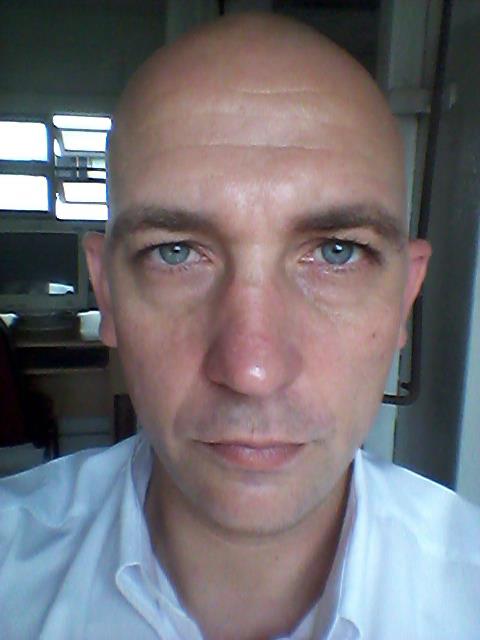
It was lunch time at school yesterday and as usual I sat on the top floor looking for something to draw. I decided on a self portrait, I’d never drawn a picture of my own face before and wondered how long I could get a drawing looking anything like me, so I took a photo with my mobile phone and started sketching away.
Self portrait in my 6 x 9 Sketchbook
I started on my right eye, left in the photograph working down to the tip of my nose then with my nose complete moved onto my left eye. Within 40 minutes I had my drawing looking something similar with the eyes and nose almost perfect. However the mouth was a little to high and so it put my face out of shape a little making it more round than long.
Photo on my Mobile Phone
For a first attempt I’m quite satisfied and even though my face was slightly out of shape I know I can only improve.
Are the objects in your drawings the correct size and shape in relation to each other?
In most of the drawings in these three exercises, especially Boxes and Books, the objects were the correct size and shape in relation to each other apart from when I started to use pen for the Jugs and Jars, but with a bit of practise I managed to get them in proportion, a better quality pen helped.
Do the shapes between the objects look correct?
Yes, one thing I don’t seem to have a problem with at this stage is the space between the objects, it helps to get them right the first time and then make sure you are looking from the same angle as you continue to draw.
Do the objects in your drawing look solid?
Yes the drawings in the Supermarket shop exercise all look solid, however the objects in the watercolour pencil drawings do not look as sturdy as the others, but with more practise I will get better at drawing with these.
Have you managed to create the feeling of depth?
I would say that in all three exercises I managed to create a good feeling of depth but more so in the charcoal sketch and the colour pencil drawing of the Supermarket Shop exercise
How did holding your pen or pencil in a different way affect your drawing?
By holding near the bottom of the pen or pencil you allow yourself more control when making marks giving you more precise lines and the control to add more pressure if and when needed. Holding a pen from the top or ‘dangling from the top’ creates less controlled, lighter marks but and can allow you to fill larger areas at a much quicker pace. By holding the pen with finger pushing down on the tip you create broad heavy strokes that are both dark and smooth.
Which drawing tools suited the different mark-making techniques you used?
For shading the best tools in my opinion are soft pencils, solid graphite pencils, graphite sticka and charcoal. Pencils, fine drawing pens, ball points and also coloured pencils are great for cross-hatching; felt tips may also be good with a bit of practise and knowledge of which is the best paper to use with these. However felt tips are great for stippling as the ink soaks into the paper quickly to leave a strong dot, drawing pens are also great for stippling.
Did you find that any marks or tools you used matched particular emotions or feelings? Did one convey calm and another frenzy for example?
This is difficult to answer, one can convey calm with tools such as soft graphite pencils, graphite sticks, drawing pens and charcoal by making regular marks, smooth lines and strokes with soft edges but then the same tool can conveyed frenzy when used in a different way on the large sheets of paper. I found that the nib (dip) pens were quite scratch and so probably created a more negative mood.
How did the introduction of colour (soft pastels, Conte crayons) affect your mark making?
Introducing colour especially soft pastels, Conte crayons, wax crayons and hard pastels was distracting because it made me realize I really need the practise and so spent more time trying to get things right than being creative. However once I had used them for the first time it left me wanting to use them more.
Which of these experiments you found most interesting and rewarding?
Definitely the Line and Other Marks exercise, it introduced me to colour for the first time plus tools that I had never used before as well as finding out how different mediums react to one other.
I originally wanted to do this exercise as quickly and as simply as possible, but then turned into something that I needed, a practise for using different medium.
I did a practise drawing in charcoal pencil rather than graphite, I probably should have sketched it out in pencil first to see if it fit on the paper as I lost the top of the box of baby food but it felt good to do something completely in charcoal.
1st rawing with charcoal and Pencil
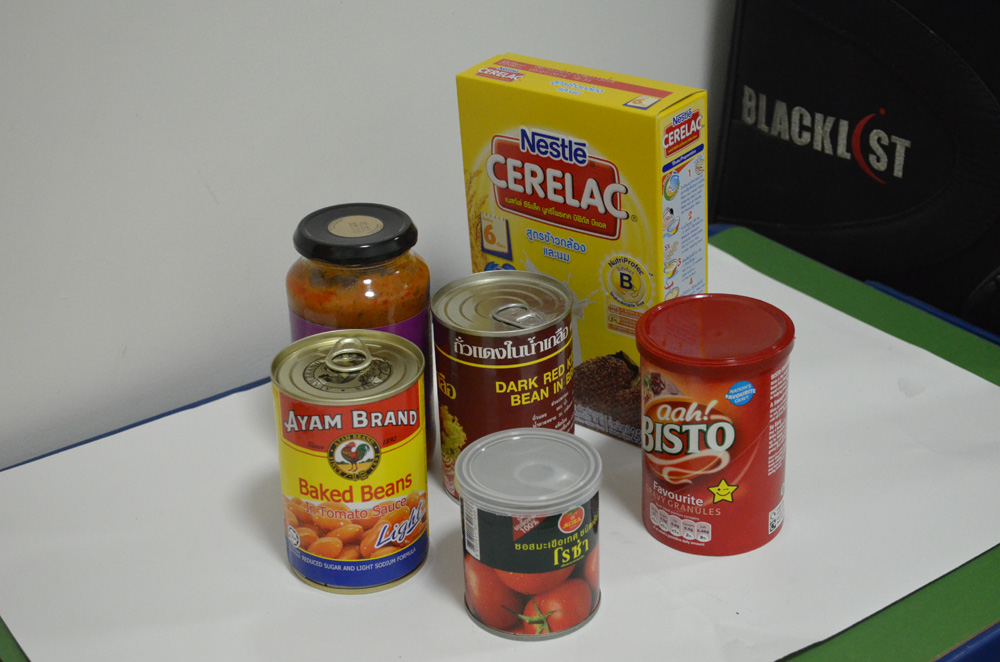
I wanted to produce the finish drawing in watercolour pencil, but I needed to get work up some confidence as I had never used watercolour pencils before so did an initial drawing in ordinary colour pencils, and I’m glad I did as it taught me a few crucial lessons.
1. I would never buy any drawing tools made in Thailand again, the leads kept breaking.
2. Next time I produce a colour pencil drawing to use paper with less tooth, rough paper is hard for blending.
3. Place objects at the best angles so I don’t have to spend hours producing every bit of detail.
4. Read the exercises in the course materials properly. Most of these objects were cylinders with only 1 box and no packets.
2nd Drawing Colour Pencil
After completing the colour pencil drawing which wasn’t great as I left a lot of text out off the objects plus the tin in the the middle was too light (the rough paper making it hard to blend) I went to do a bit of shopping. This time I purchased Faber Castell watercolour pencils not trusting the Masterart ones I had in the drawer and some A3 watercolour paper.
I changed a few objects, I had to use the gravy for Sunday dinner so swapped that for parsley sauce, swapped the tin for a big bag of Nesvita cereal drinks, took the plastic lid off the Rosa tin and swapped the baked beans for a bag of Tipco something or other that the school director gave me for Christmas.
3rd drawing watercolour pencil on watercolour paper
I’ve never used watercolour pencils or watercolour paper before so instead of spending hours trying to learn how to use them through trial and error I jumped onto YouTube to have a look at a couple of videos.
However once I started the exercise I learnt some more valuable lessons:
1. This probably want the best medium for this exercise with all the writing on the boxes.
2. I probably should have used a heavier paper, the 190 I was using begun to warp like mad.
3. The video was not enough I should have practised before doing this exercise.
Even though I did not rush through this exercise (it took a good few hours split up over a couple of days) the final drawing in my eyes looks a complete mess due to the very reflective purple box in the middle that made me lose my rag. However I am happy that I allowed myself the chance to start using watercolour pencils and to be honest for the first drawing ever with this medium, I don’t think I did too bad even though it does looks better without my glasses and my eyes squinted.
Overall the shapes were fine, the shapes between the objects were pretty much perfect and there is depth there so in that respect I was successful.
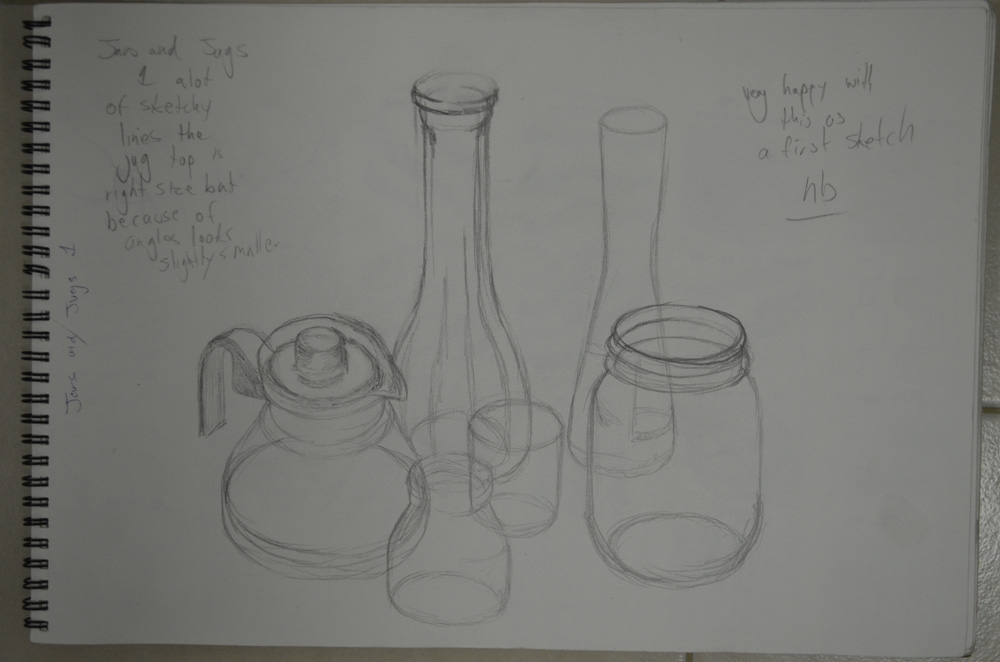
For this Jugs and Jars exercise I collected together 6 cylindrical objects including jars, vases, bottles and jugs as well as a glass and arranged them so I was looking slightly down at them. Then with a softish pencil I drew what I could see, then rearranged and drew them at a slightly different angle.
I flew through the pencil sketches in a matter of minutes as I had no fears of getting it wrong, knowing that I could always work the objects into shape with a few extra strokes.
1st Sketch HB
I then moved the objects around and drew them from different angles and again, I breezed through this part of the exercise and the only time I used an eraser was to restart drawing the first object as I worked from left to right and I started drawing the glass teapot a little too low that the small jug at the front would have been off the page.
2nd sketch HB change of angle
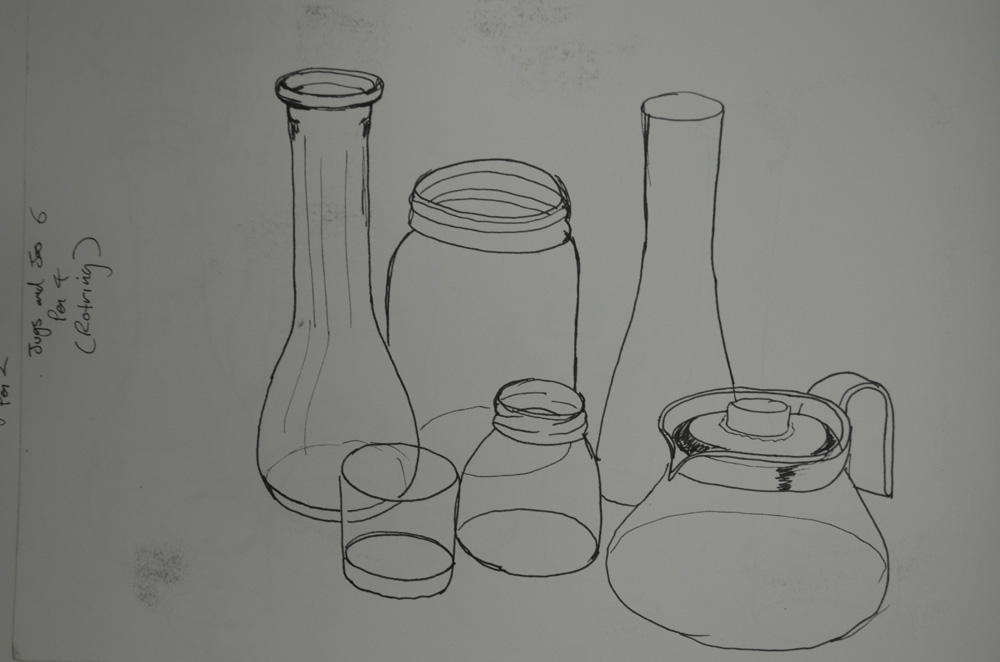
When it came down to drawing with pen I got nervous, knowing that I couldn’t erase anything, even though I hadn’t need to make real corrections while using the pencil and with this in my head I began to mess up and make some real mistakes. I drew the first couple of pen drawings with an Artline 0.3 Drawing pen and it was pretty crappy and scratchy, so I was forced to purchase a couple of Rotring Drawing pens.
1st Sketch with Artline Drawing Pen
I found it a lot easier and smoother to draw with the Rotring so it gave me some confidence back but it would still take a lot of practise to get it right first time with a pen without using any kind of scaling system or going through it in pencil first.
While looking for a Vincent van Gogh pen and ink drawing I came across his ‘Rocky Ground at Montmajour’ the finest example of this was on Bridgeman Education:
I chose this picture because it is a great example of how Van Gogh uses very simple marks to build up an intricate scene. The types of marks that he uses such as squiggles, dots and dashes are very clear in the picture and yet the image still has great volume and texture.
For the sand in the foreground Van Gogh uses small squiggles that almost resemble tiny letter m’s while for the boulders that separates the sand from the grass he has used larger more irregular shapes with squiggles and circles to indicate erosion marks in the rocks.
Van Gogh used different line lengths for the grass with short, close to vertical dashes for the shorter grass while the longer grass is made up of longer and sometimes thicker strokes drawn at different angles to give a sense of coarseness.
The smaller bushes and trees are made up of curved lines as is the bark of tree in the middle, however, he seems to have used a very loose form of squirkling (connected squiggles) for the leaves and branches of the tree in the middle. He has also gives the viewer a sense of distance when looking at the tree on the right of the picture by drawing long vertical lines that depict a distant field, while the colour of the ink in the rocks in the foreground is much darker to give a sense of closeness.
The clouds in the sky seem to be made up of long thin zigzags while the bird flying in the sky is has been drawn with two short thick strokes.
It really is inspiring to see how such simple marks can make up such a complex image and I can’t wait for the opportunity to occur when I can do something like this.
After enrolling on this course I realised how lucky I was to be working at a temple school with it’s open plan floors and Thai style roofs and architecture. So today I took time out to have a sit down and actually sketch what I see every day and I made a promise to myself that I will put pencil to paper every chance I get.
This was the first of what I hope will many sketches of this wonderful working environment and in 35 minutes I think I did quite well.
For this exercise of drawing a pile of six mixed boxes and books I decided that I would approach it from two different angles, with the easel and without, both with an hb pencil. Knowing that I would be rocking back and forth from the easel hence changing perspective I was intrigued to see how the drawing would turn out, plus I hadn’t had the easel out for a while.
my workspace for this exercise
After a play around with the books I optedto attempt drawing the books at probably one of the worst angles I could put them in with the back corners of all, almost in-line.
tower of boxes and books
I was right about using the easel, even though the stack of books and boxes were in perspective the finished sketch did not look like I had drawn it from the angle I had aimed for. I also drew from the bottom book up which I found was more difficult as it is easier to draw down.
drawing with easel from bottom book up
For my second go I packed up the easel and settled for the sketchbook on my knee approach, and drawing with my head back in the chair I managed to get the books in almost the right position every time. This time I drew from the top box down to the bottom book and turning my sketchpad around as I pulled the pencil towards me to get better lines and angles I sailed through it in about 25 minutes.
first drawing without easel top box down
This time I wanted to have another go without drawing the lines through, I could have just erased all the lines on the second drawing but i decided I needed the practise so started a fresh. I drew the top box a bit bigger than it should have been and so the angles were slightly out and I almost lost the bottom of the book, but I was still happy with the finished result and so I added to the drawing with a little bit of detail.
drawing without lines through, no easel, top down
Taking design and communication all those years ago at school paid off on this exercise but the true trick was to place a dot where the corners should be and then draw towards them, that way there is less line correction needed.
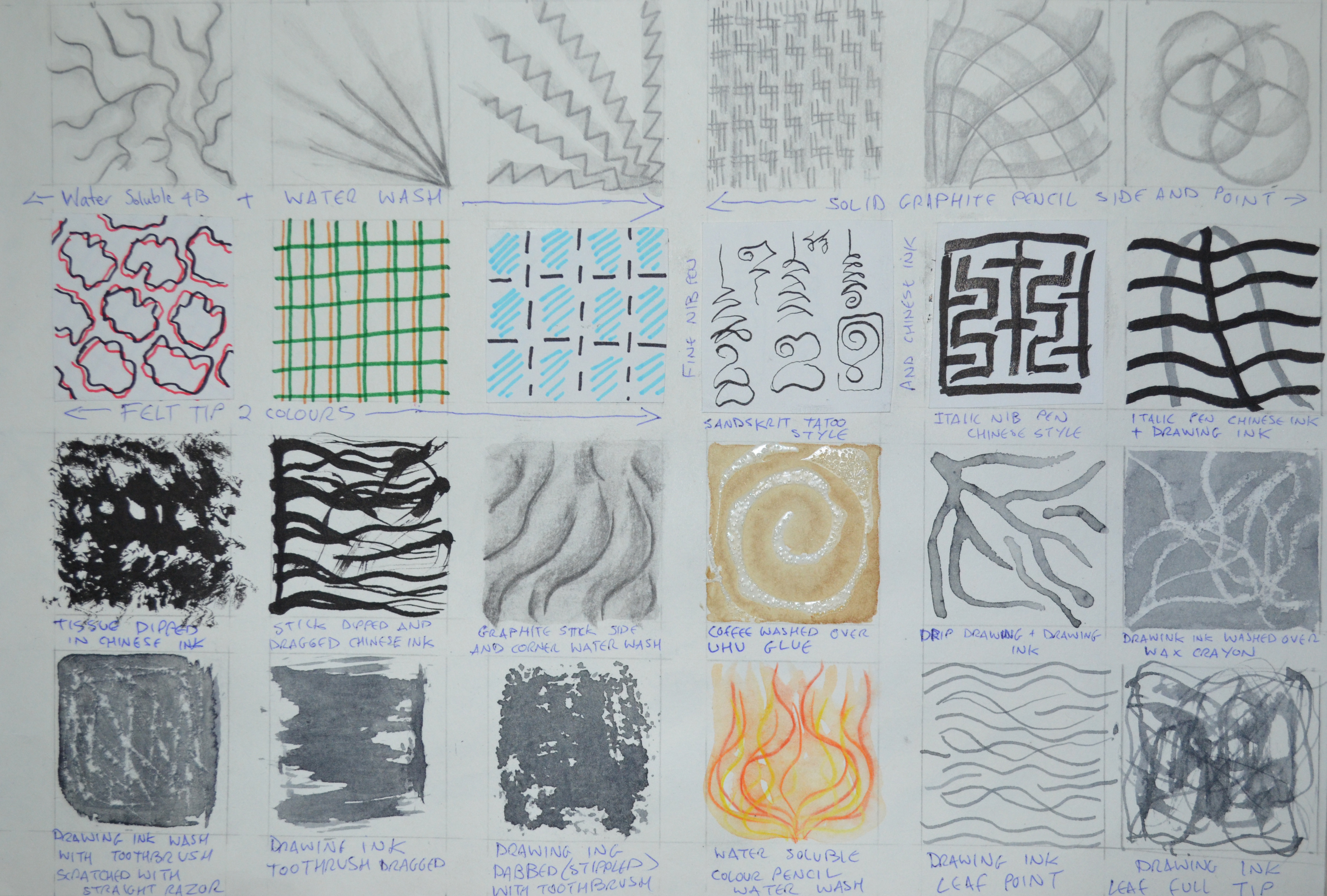
The object of this exercise was to draw lots of 5 cm squares in my sketchbook and fill them using pencils and pens practise several different marks in each square, thinking about intensity, texture, smoothness, pattern, length and repetition.
Now after reading the words ‘practise several different marks in each square’ there was a danger of either turning this exercise into another ‘Doodling’ exercise or making the squares look like swatches for a textile course. I wanted to avoid both so I looked a few different existing OCA Drawing 1 blogs to see how others had tackled this exercise.
The benefits of other students having their blogs online is that you can see how others have gone about completing each exercise, the drawbacks of this is that one can go look at someone’s blog and then feel a little bit restricted for risk of going too close to someone else’s work; but then it does force uniqueness or at least it did with me.
The materials I used for this exercise were, pencil, coloured pencil, bic, water soluble pencil, solid graphite pencil and graphite sticks as well as charcoal, Chinese ink, nip pens, marker, whiteboard marker, ArtLiner drawing pens and Chinese white pencil.
Pencil, Bic and Colour Pencil
I found that I used the HB pencil a lot until I came out of my comfort zone, it’s a tool that’s easy to rub out if I’m not happy with what I’ve done but then I realised at this stage I should allow for going overboard or getting sloppy as it is those little mishaps that will help me ‘learn’. I also found that I kept going back to shading and the hardest part of this exercise was trying not to repeat anything I had done in earlier exercises.
As I tried to move onto different media I kept realising that there were still other marks that I could do with pencil. Holding the pencil in different ways and at different angles gave me different effects, holding it in a writing position I created smooth, strong lines while holding it at the end gave me uncontrolled, sometimes smooth but then sometimes rough lines, depending on the direction I took.
Creating patterns through repetition was not only great for conveying a feeling of depth but was a good transition point to help me to move on to using other media, otherwise I could have been there all day (just a figure of speech, this actually took me three evenings).
Pencil, Drawing Pen, Charcoal, Graphite, Nib Pens and Ink
With the size of the squares (just 5 cm) I spent a lot of time practising on large sheets of paper not having the confidence to go straight into my sketchbook with the softer mediums such as charcoal and the messier mediums like ink.
Nib Pens – This time I had a lot more confidence with nib pens knowing exactly how much ink to put on them and how to ‘put pen to paper’ and what direction is best with each nib to give me different lines. I used two different nibs, 1 Italic which was nice and smooth and 1 very fine nib which was very scratchy and didn’t feel that comfortable with but it was great for doing the Khmer style marks in the third photo.
Trying New Media
Too be honest I wasn’t that eager to move onto other mediums, but once I did, I really started to enjoy myself. I was limited to what I had, it might take me forever to find a descent quill in Bangkok, but a walk in the communal garden on the 5th floor got me a leaf and a stick.
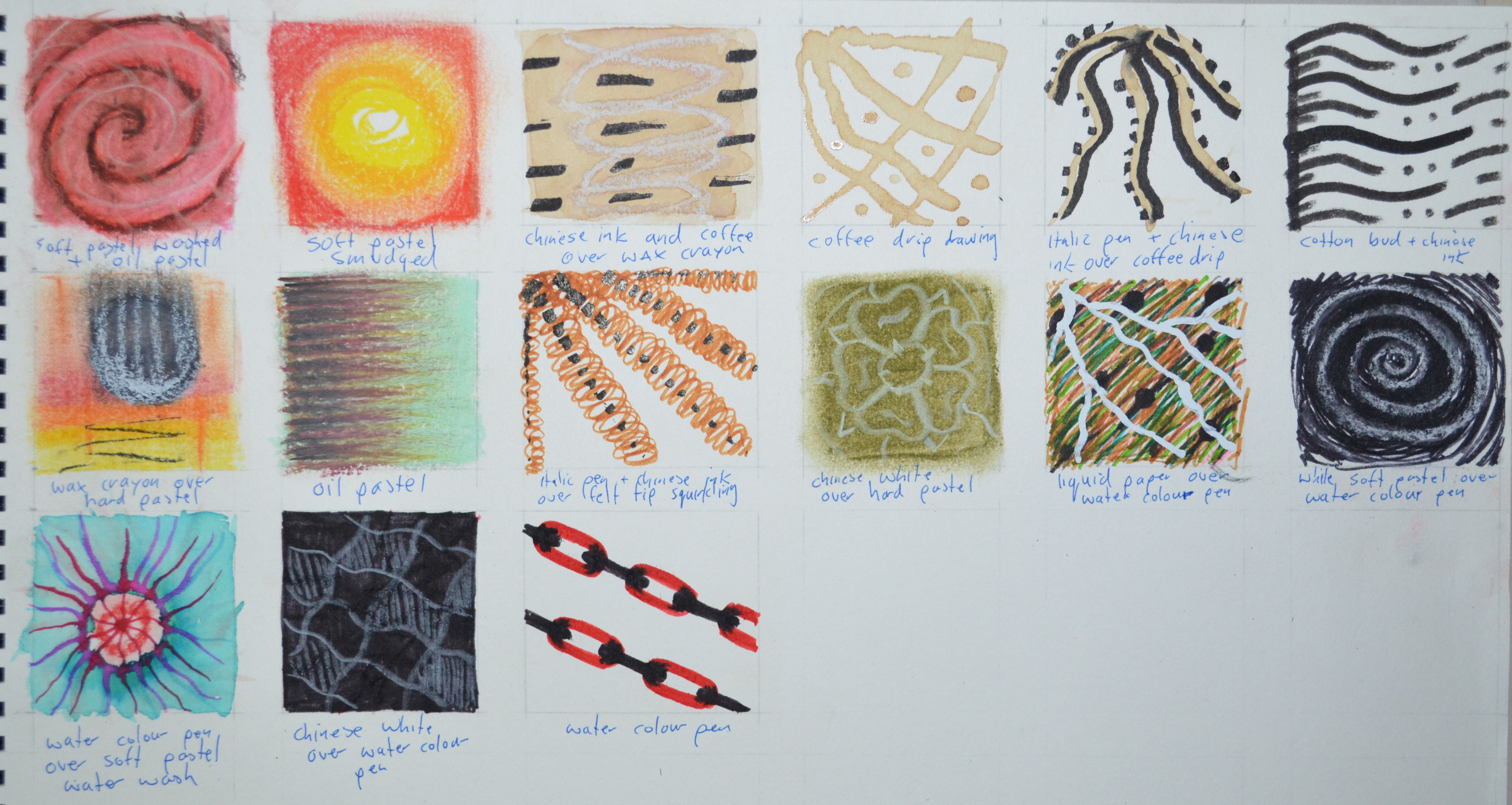
The new media I used for this were watercolour pens, water soluble coloured pencils, water soluble graphite pencils, coffee, drawing ink, hard pastels, oil pastels as well as wax crayon, solid graphite sticks, UHU glue, liquid paper and a Derwent Chinese white pencil. I also used several different drawing tools including a scrunched up tissue, nib pens, a stick, a leaf, a toothbrush and a straight razor plus a couple of new techniques such as drip drawing and washing over several of the new mediums with water and a fine brush.
Trying Other Media, Glue, Leaf, Stick and Straight Razor
It took me a good few squares to really get into this but my hunger for new mediums really started when I drew with the stick dipped in Chinese Ink, with just one stroke of the stick I made both thick strong lines and thin whipping lines which were both chaotic and rhythmic.
I had the idea of washing coffee over UHU glue while I was at the gym for some strange reason but I’m glad I did. I could have created many different patterns by doing this and practised a few times on large sheets of paper but the easiest one given the size of the square was the swirl which created a wonderful blended effect.
Coffee washed over UHU glue with a fine brush
Even after practising on large sheets of paper when it came to repeating it in the squares on my sketchbook I still messed up. The solution to this was either cut the successful practise from my large sheets and glue it into the squares or to try and make something else of it. When I tried brushing sideways with the toothbrush dipped in drawing ink I got nothing but a large dark grey surface, determined to get something out of this I attacked the surface with a straight razor. The result of this was very raw but it is something I can use later.
Pastels, Coffeee, Watercolour pen, Cotton Bud and Wax Crayon
I got some great results washing ink over wax crayon and in some ways it looked like the negative of a drip drawing which I also successfully pulled off in both ink and coffee.
I also really enjoyed the watercolour pens that I have been using as felt tips which gave me some great oil type patterns when drawn with on a wet surface, and drawing with liquid paper over mixed coloured felt tip lines produced very dramatic white lines.
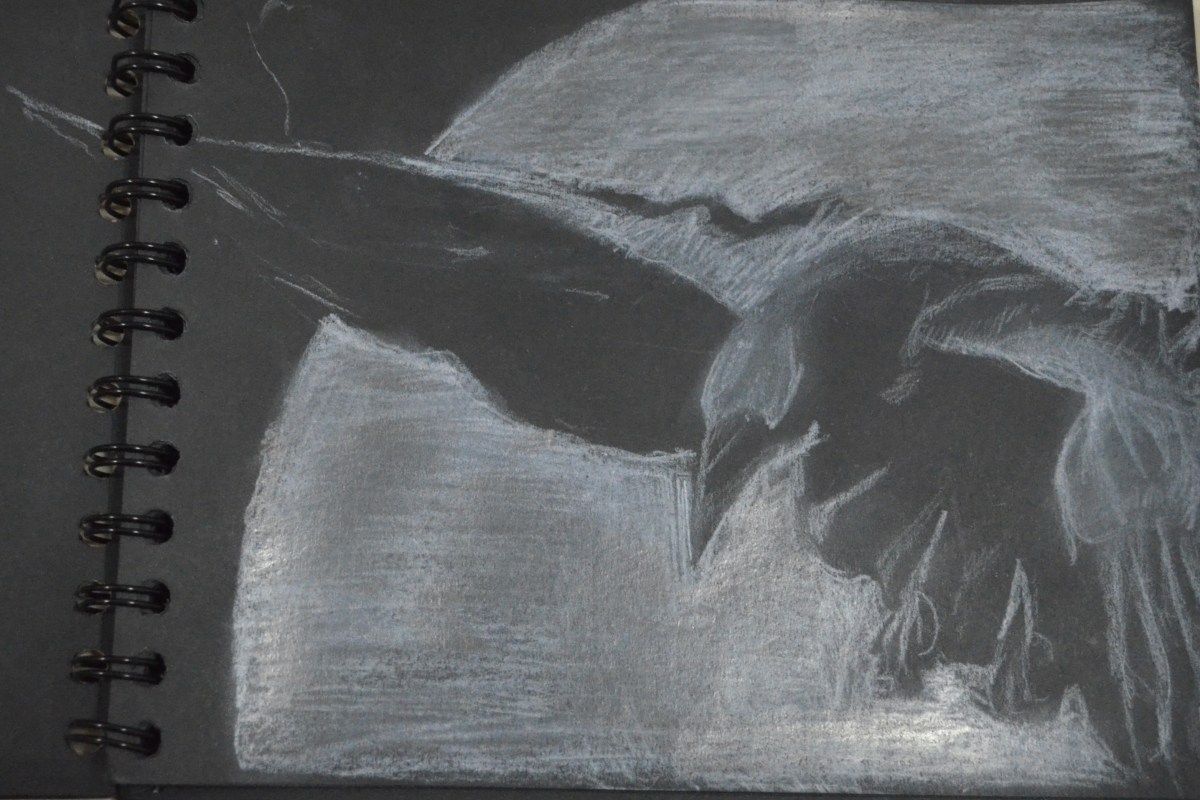
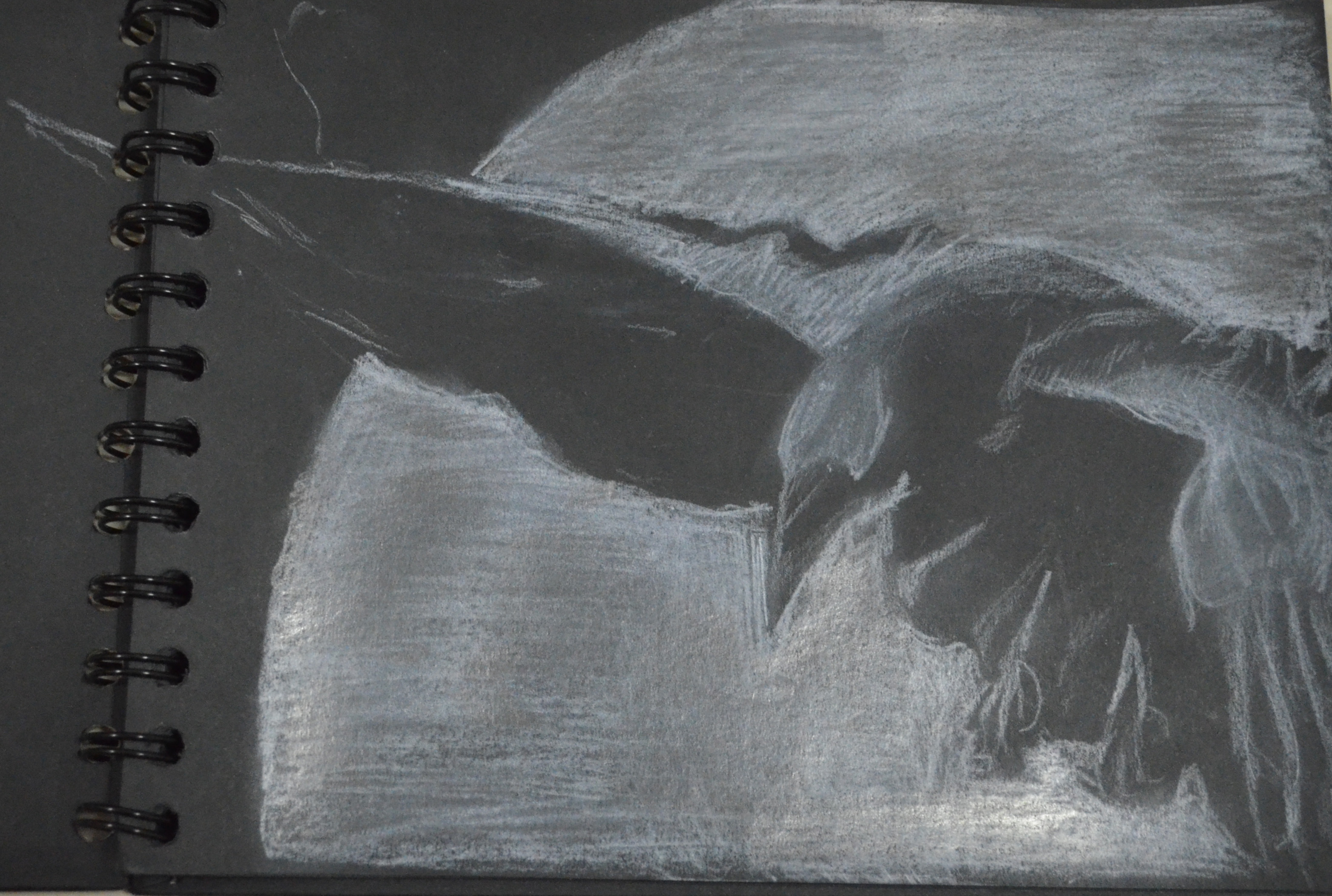
This was a quick sketch to christen my new black pad.The raven is my favourite animal and I wanted to know how it would look drawn on black paper with a Derwent Chinese White colour pencil. I completed the sketch in about 40 minutes (with distractions) and I would have rather have drawn this without the moon but without it it wasn’t recognisable as a and kind of bird. I have a feeling that this pad will be filled with crows by the time I’m finished.











 My Drawing Course