Shadows and Reflected Light and Shade

Finished Drawing, Shadows and Reflective Light and Shade

In this exercise I was instructed to ‘Use charcoal, a putty rubber and pick two objects with shiny reflective surfaces. Decide on the size of the composition, use A1 or A2 paper so that you can do bold strokes. Try to fill the paper with your objects showing the reflected light and shade of one object falling on another and try to leave very little background space.’

Shadows and Reflective LIght and Shade
Photo of Chosen Objects, Sieve and Ladle

I went out and purchased a few objects specifically for this exercise, after putting them together in pairs to see how they reflected off each other I settled for what I think is some kind of sieve and a ladle. I chose A2 for the composition because my drawing board wasn’t big so an A1 size drawing board will be my next purchase. The brief said to leave very little background but I wanted to show some of the handle of the ladle and the shadow that it cast but to be honest I could have shown a lot less and made the objects bigger.

Drawing Pattern of Shadow with Charcoal
Drawing Pattern of Shadow

I sketched an outline with an H3 pencil then as instructed I drew the basic pattern of shadow first with sweeps of charcoal. I did try hatching but the charcoal seemed to leave too darker marks on the paper even trying the charcoal at different angles, this may have been down to the smoothness of the Carson paper that I used.

I tried to stay away from smudging the charcoal as it said nothing about it in the brief but when I did resort to smudging my finger took too much off so I used a stump that I forgot I had. It was great for smudging the charcoal without taking too much off as well as drawing solid outlines. I think if I had used A1 sized paper I could have probably had a better chance of completing the drawing using hatching.

Finished Drawing, Shadows and Reflective Light and Shade

I did start off with the darker tones on the ladle but just on the inner shadows to make sure I was drawing the correct shape (hopefully in time I’ll get more confident with charcoal) and then once everything was fine I switched to the mid tones and then built up to the darker tones.

For the lightest tones and the light reflected from the bendy lamp I used a putty rubber to erase the charcoal. I bought a couple of Conte  knead-able erasers which were much better quality than the ones I bought when starting off the course which stuck to everything in the Bangkok heat and left debris on the paper.

I enjoyed the exercise and proud of the result but I am still lacking the confidence with charcoal. I seem to still have a lot more to know about the different types of charcoal, if time allowed I would have liked to have done this again on an A1 sheet of paper to see if I can do the whole exercise without smudging.

Study of Light Reflected from one Object to Another

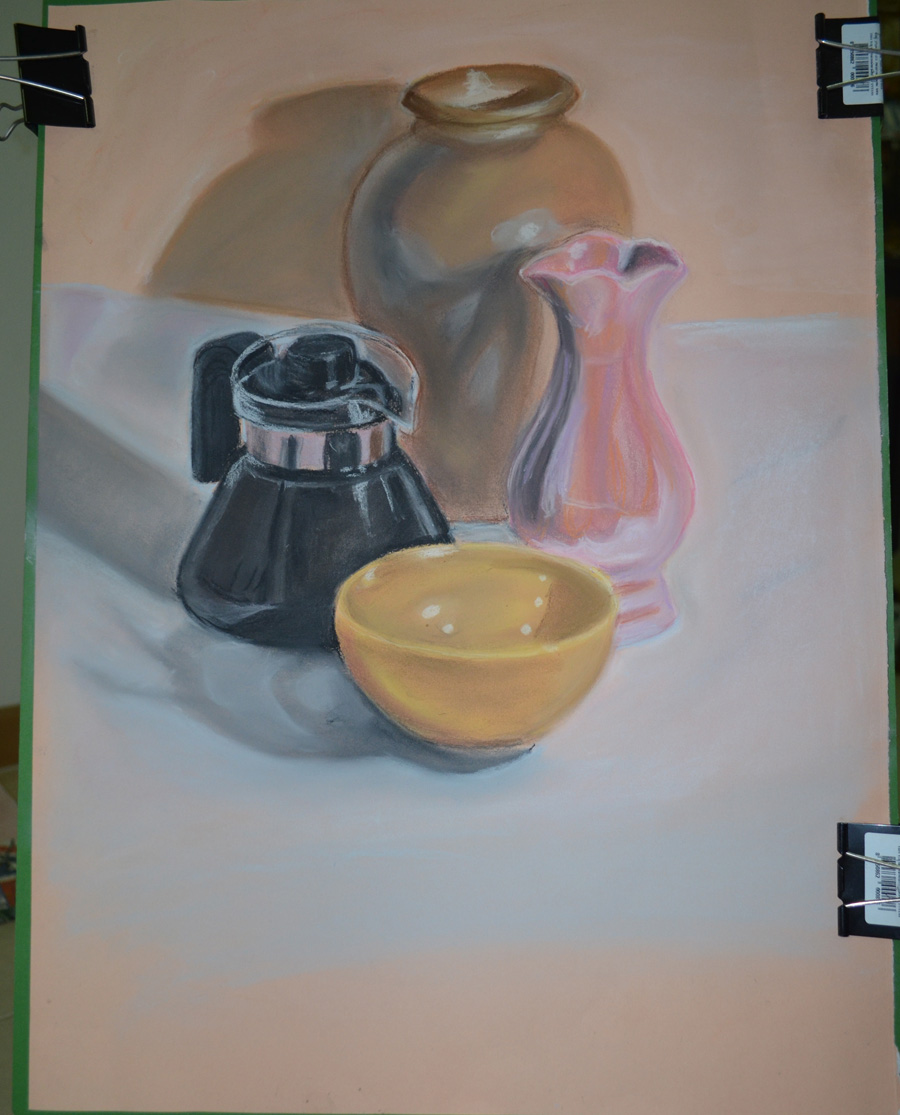
The brief was to ‘Arrange two three objects ,  at least one of which has a shiny reflective surface, side by side with a small space in between them. Place a light source so that it is to one side of your (two) objects to cast clear shadows. Sit so that you can easily see the shadow on one side of the objects and the light on the other’.

Objects with Coloured Paper Background

The first sentence said two or three and the second paragraph said two but the example students drawing had quite a few objects so I want for four, which were a ceramic bowl, a pearlescent vase, a Chinese style vase and a glass teapot. The glass teapot had a chrome band around it but it didn’t cover a large area so I filled it up with a very strong black coffee in order to make the glass more reflective

The sample student drawing was on coloured paper which gave me an idea, so I bought some large sheets of orange coloured paper and set one as the background and did the drawing on the other. The medium I chose for this exercise was hard pastel by Cretacolor, I had never drawn with hard pastel before and this was the perfect chance to lose my virginity.

I was instructed to draw the main shadow pattern created by the light source first then add the reflective light and shadow patterns to the drawing. I followed the instructions drawing it in graphite pencil first as I knew that when it came to add the shadow patterns and reflective light with the hard pastel I would have to work on an object at a time due to how much work blending in this medium needed especially on the coloured paper that I chose.

A Close up of my Finished Drawing in Hard Pastel

I found that I bit off more than I could chew and it took me about 6 hours to finish the exercise, and the colours on the objects in the drawing were quite different from real life, I find blending most mediums quite difficult and really need to spend more time experimenting before working on a piece.

Although happy with the finished drawing I feel I have let myself down and could have gone out of my way to find better objects that were more reflective, although the teapot reflected the colour of the other objects quite well over the small reflective area, the pearlescent vase also did quite a good job.

I could have also done a better job of positioning the objects on the paper which was approximately A3 with about a third of the paper gone to waste.

The valuable lessons that I have learnt from this are that I should choose my mediums and objects wisely and  to use more of the paper next time.

Bad Example of Paper Wastage

Tone and Form – Tonal Studies

The brief of the first part of this exercise was to draw four 5 cm squares in my sketchbook using 4 different drawing tools such as a pencil, drawing pen, nib pen and black ink and a ballpoint pen. Try to make 4 distinctive grades of hatching with each square without paying too much attention to detail, suggesting that we have close our eyes as this will help eliminate most of the detail.

I totally read this wrong, drawing the squares in pencil and then hatching within the square using the 4 drawing tools that it gave as examples as above. I tried different types of hatching to do this including, cross hatching at an angle as well as using horizontal and vertical lines to give a much denser tone. The nip pen was probably the most difficult for me and couldn’t quite graduate the tones.

Tone Using Hatching
Tone Using Hatching

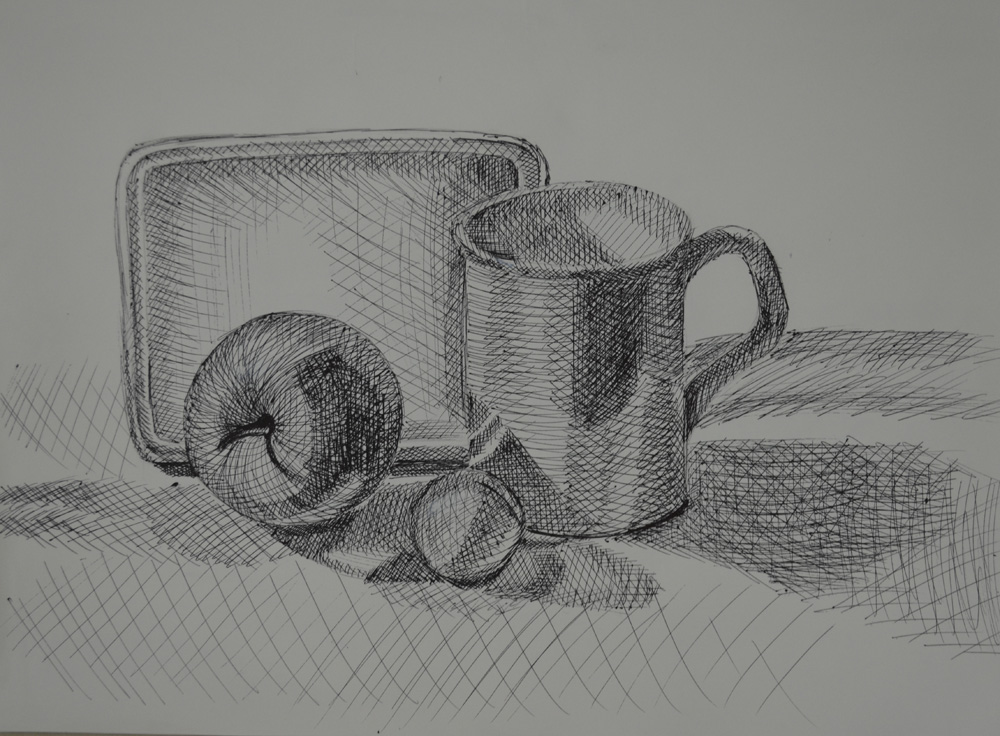
The second part of the exercise was to arrange 4 objects such as an apple, orange, ball, cup or other kitchen utensils, draw the objects then use a hatching technique to technique to add tonal shadow patterns to these objects. The 4 objects I initially chose were a mug, a small bowl an apple and a pong pong ball and chose to have a go at cross hatching with a Faber Castelle Ballpoint pen.

1st Drawing Using Ballpoint

I failed miserably in my first attempt, I even forgot I was hatching with a pen at one stage and went to smooth the pen and smudged the ink across the paper having to fill in the background to cover it up. However it did give me some well needed practise.and confidence towards the end to have another go with the ballpoint pen.

2nd Choice of Objects
2nd Drawing Using Ballpoint

My second attempt was much better, this time I swapped the bowl for a tupperware container turned on its side and I could clearly make out what each of the objects were in my finished drawing, well…apart from the ping pong ball that is.

3rd Drawing Using 2B Pencil

For my third attempt I went back to a 2B graphite pencil, the tool I feel most comfortable with and successfully cross hatched the whole drawing without smoothing any lines with my finger and this time even the ping pong ball was clear enough to make out in my finished drawing,. I think deciding to start off the exercise with a ballpoint pen was a very wise idea and may have even helped to improve my cross hatching technique.

Observing Light and Shadow Formations on a Surface

The brief for this exercise was to place two objects together and position a lamp so they are lit from one side, or natural light if its a bright day. Originally I wanted to get out on the balcony during the daytime but housework took me right through to early evening, so I settled for a bendy lamp in the living room and I’m glad I did because it threw more definite light on the objects that I chose, which were a Johnson’s Baby Powder bottle and a ceramic cup.

2 Drawings Light from Alternative Sides

I started with a simple sketch that I knew I could alter as I shaded back through the drawing. I begun with the mid tones but was very tempted to start on the darker tones first. The objects were placed on a glass table, however I put some paper down on the table top to cut down on where the reflected light was came from.

Light from Left Hand Side

I was very happy with the first drawing, the sketch itself took me about 10-15 minutes and the areas of dark and light were very clear so I didn’t think it would take me long to complete the shading, which in the end took me well over an hour. To complete the drawing off I shaded in the background as the edges on both of the objects were quite light and I wouldn’t have been able to show that on a lighter background.

Light from Right Hand Side

For the second drawing I pointed the lamp on the opposite side, which gave me different shadows and light and dark tones in different areas so between the two drawings I think I managed to get quite a lot of practise.

I really enjoyed this exercise but would have probably preferred to do it in colour as the cup looks more chrome than ceramic done in pencil.