Check and Log – Drawing Fruit and Vegetables in Colour

2nd Attempt at Dip Pens

Your composition should occupy most of the paper’s surface. How much negative space do you have left?

I think I did really well with all the three exercises of this project, ‘Using Hatching to Create Tone‘, ‘Using Markers or Dip Pens‘ and ‘Drawing Using Oil Pastel‘. In all three final drawings I left minimal negative space allowing for shadows and props used.

What have you learnt from drawing the details of fruit and vegetables?

All fruits and vegetables have different surfaces from smooth and shiny to rough, hairy and spiky so every object is a challenge not only this but its very difficult to get familiar with the shape of a certain fruit or vegetable as the surface differs from one to another taking into consideration ‘ripeness’.

What did you find most challenging about this part of the course? 

Firstly, I really had problems using dip pens and creating tone with this medium it is something I really have to work hard at getting as much practise in as possible.

Secondly composition arrangement and that arranging a composition with fruit and vegetables takes more time than arranging other objects; not only for fear of repeating a similar composition you drew in a previous exercise  but for fear of arranging a composition that will not allow you to capture the full details of the objects.



Detailed Observation – Check and Log

Exercise - Stipples and Dots, Finished Drawing

Which drawing media did you find most effective to use, for which effects?

For me I love pencils I’ve been developing my pencil skills more and more on this course and I have got to the stage where I am doing less and less smudging and more and more hatching using my pencil at different angles with different holding techniques. I really think I did well depicting the tone of the wood and especially the bark in the ‘Getting Tone and Depth in Detail‘ exercise. However I was very happy with my stippling with the Rotring drawing pen on the ‘Stipples and Dots’ exercise, not only being able to depict the tone of the leaf but also it’s texture.

What sort of Marks work well to create tone and texture?

I used a variety of hatching to depict the texture of the tree branch with sporadic hatching to depict the bark and fluid lines and hatching to show the stripped wood all these marks worked really well. I thought I had chosen the wrong type of subject for the stipples and dots exercise but I think I showed the texture of the object really well with dots and patterns of stipples to show creases in the dying leaf.

Did you enjoy capturing details or are you more at home creating big broad brush sketches?

I must admit that capturing details with stipples and dots was a bit tedious but I am delighted with the finished drawing and I really enjoyed working on the tree branch in the first exercise so I can probably say that I am more at home capturing details.

Look at the composition of the drawings you have done in this project. Make some sketches and notes about how you could improve your composition.

The composition and the angles of the subjects that I chose were thought about long and hard before embarking on these exercises, I feel I chose the best compositions that I could to not only capture the full beauty of the objects but to fill the paper.

Check and Log – Exploring Coloured Media

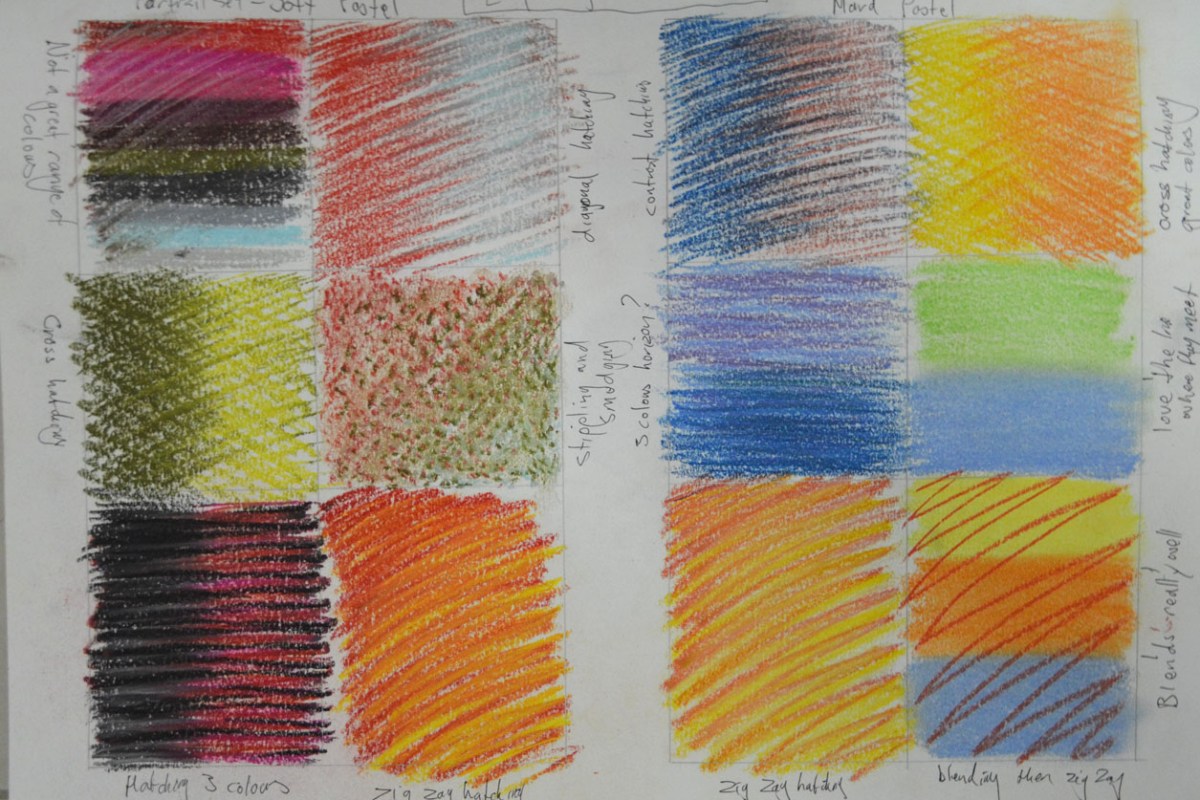
exploring coloured media - Soft and Hard Pastel

Which of the media you have experimented with did you find the most expressive?

From experimenting with the different colour media in this exercise I would probably say at this stage that the oil pastel is the most expressive. Oil pastels seem to allow more sketchy fluid strokes and seems to work well with all the techniques that I have practised so far.

Which medium do you think lends itself to more detailed work?

From what I have seen so far I would say coloured pencils as well as ball point pen but then again I do not think I have worked with nib pens and ink enough at this stage to dismiss these as a medium for more detailed drawings

Reflected Light – Check and Log

What are the difficulties in separating cast shadow from reflected Light and shade?

The difficulty in separating cast shadow from reflected light and shade is that there is very little tone difference between them and makes it hard to determine which is which. However the fact that they fall in opposite directions does help to determine which is which.

The reflected shadow and light follows the contours of the objects how have you shown this in your drawing?

To show how how reflected light follows the contours of the objects I used fluid strokes and hatching techniques as well as following the contours with a putty rubber.


Assignment 1 – Check and Log

Assignment 1 - Natural Forms - Variations and Materisla Used

Did you do enough preliminary work before starting on your final pieces?

Yes definitely, the preliminary work not only helped me decide on the best composition for the final piece but helped me to decide which mediums I should use. In both parts of this assignment it changed my mind about what mediums I would use and also the layout of the composition for the final piece. I probably could have done more with regards to colour blending and make more notes on which colours to use for the Natural Objects.

Do your large drawings give an accurate interpretation of the still life groups? If not, what went wrong?

The large drawing for Made Objects I believe was a very accurate interpretation of the still life group even after playing down certain details such as the amount of bars on the electric fan cage. However I I’m not too happy with the interpretation of the still life group in the large drawing for the Natural forms. There are certain shapes on the edge of the drawing that I know are not the same as the actual objects this was due to moving the objects about trying to find the composition that I chose to develop, then having to work from the drawings I had already done and photos that I had taken.

Did you make a good selection of objects or did you try to include too much?

I believe I made a good selection of objects for both parts of this assignment with a minimum amount of objects in mind as I set out on each project.

Do your drawings fit well on the paper, or could they be improved by working on a larger sheet of paper?

The drawings do fit well on the paper but I do feel that both compositions may have been improved on a larger A1 sheet of paper because of the objects that I chose for the Made Objects and for the medium that I chose for the Natural Forms.

Did you have problems with drawing, or find hatching too difficult?

I don’t feel that I have any problems with drawing, any problems that do have are probably from the lack of experience with certain mediums. In the Natural forms part of the assignment I thought I did quite well in developing my hatching skills with hard pastel.

Using Texture – Check and Log

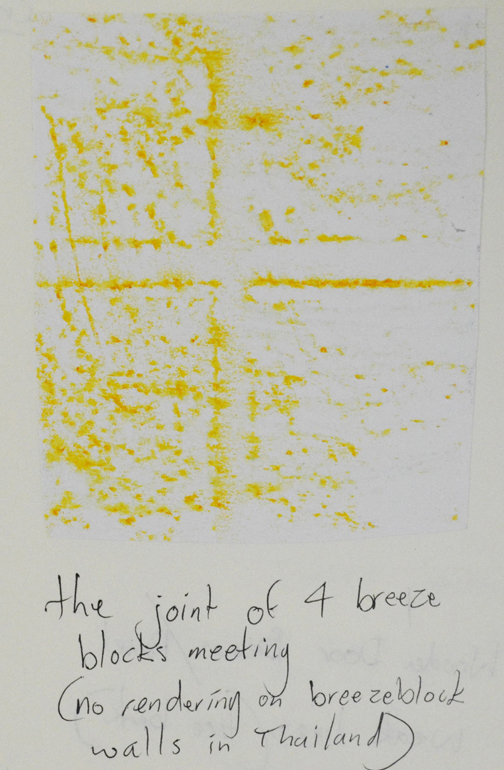
Yellow crayon on breeze block wall

Have you discovered any new ways of using your drawing tools to depict surface and texture?

Not as much as I wished I had, there were a few things that I couldn’t find here in this part of Bangkok such as a chunky sponge, I would have loved to have tried dripping or splashing ink for the texture of this. However I did discover new ways of hatching for as in the the fur of the teddy bear, hatching with small strokes in flowing patterns. I also discovered new ways of using my putty rubber to show texture such as twisting for the mop rug underneath my composition.

a Drawing with Textures - Second Drawing
a Drawing with Textures – Second Drawing

How successful were you at implying form with little or no tonal hatching?

I seemed to use some kind of hatching for nearly everything except the mop rug. The technique that I used to depict the mop strings (as I would call them) showed real depth. This was a mixture of squiggles, circles smudging and twisting with a putty rubber and it worked well.

What are your impressions of frottage as a drawing technique?

I really love the idea of using this as a drawing technique and I love the way that a surface of one thing can give you a totally different result to what you thought it would and how something as simple as the joint of 4 breeze blocks can give you an idea for a drawing of a crucifixion or graveyard scene. The best thing about frottage is that you can use it for texture in drawing you are already working on or it can give you an idea for a new drawing.

Yellow crayon on breeze block wall


Still Life – Check and Log

exercise 2 still life of made objects

Do you think it is easier to suggest three dimensions on man-made or natural objects?

This project has taught me that it is easier to suggest three dimensions on man-made objects rather than natural objects. Man-made objects are usually made up of geometrical shapes such as cylinders, cones or cubes and so the lines of man-made objects are easier to draw and suggest their 3D form using most mediums. The irregular shapes of natural objects means that their three dimensional features are much more subtle with lines that are more difficult to depict and draw.

How did you create a sense of solidity in your composition?

In the exercise ‘Still Life Sketches of Made Objects’ I created a sense of solidity by using various hatching techniques and swapping between pencils of different hardness mainly B, HB and 2B, shadows and tone also played a big part in making the objects look solid.

exercise still life of made objects
Image 1: Exercise – Still Life of Made Objects

In the exercise ‘Composition of Natural Objects‘ working with watercolor pencil I used hatching and layers of darker colour to show solidity.

Composition of Natural Objects
Image 2: Exercise – Composition of Natural Objects

Do you think changing the arrangement of your composition makes a difference to the way you create a sense of form?

Changing the arrangement of the objects changed the way each objects interacted with each other, shadows and light reflected off one object to another and other objects in the composition (such as the plate in image 2) can play a major role in creating a sense of form.

How did you decide how to position yourself in relation to the objects?

For the second exercise I decided to position myself slightly above looking down at the objects so I could see the full form of the the objects and shadows interacting with each other in the middle of the composition, I thought this would help me to create a sense of form in my drawing. A bruised rib from a an accident the day before helped me to reinforce this decision.

Tone and Form – Check and Log

How difficult was it to distinguish light from the primary light source and secondary reflected light?

I was very aware of where the light was coming from on the first two drawings of the Johnsons baby Powder Bottle and Mug in the first exercise, and even clearer while working on the second sketch. There were other light sources in the room as I worked on them in the evening but still it was quite easy to tell, I think using the ceramic mug helped.

In the second exercise it was not so easy to tell but I did know what to look for so it helped; the easiest reflections to make out was the light reflecting from the ping  pong  ball on to the apple. But even though I knew  which light came from the primary source I wasn’t quite sure where certain reflections of light on the mug were coming from. I could only guess.

How as awareness of light and shade affected your depiction of tone and form?

I could have gone my whole life missing certain reflections and shadows out, saying to myself ‘Yeah, that’ll do’, trying to copy as precisely as possible, thinking that’s enough. However, these two exercises have made me more aware of reflected light and I’m starting to piece together where the light in certain places is coming from, this has helped to make these drawings more realistic than anything I’ve done before so it’s something I will continue to observe.